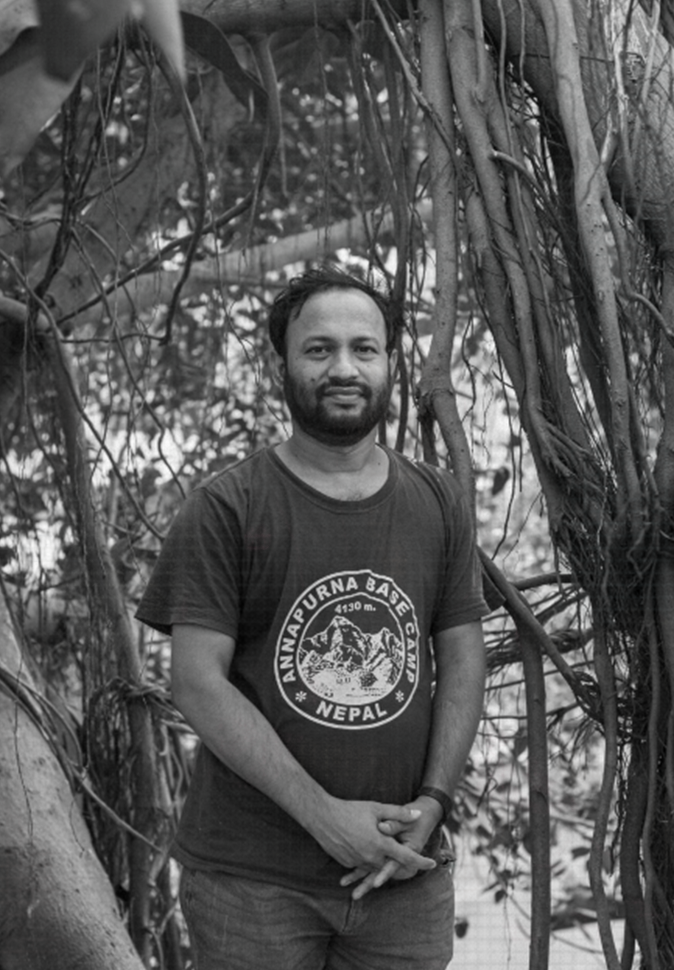
Hasan Robayet is a poet who steps first toward democracy and the people. “I emphasize democracy, democracy for all. People are the owners of our country, so only those elected by the votes of the people may rule. I emphasize the people's will.” What pushed him was not party rivalry but a core principle. “Past governments have not cared about the people's will. They became anti-people government. A people's republic must not have an anti-people government.” For him, 1971 is the compass. “In the history of Bangladesh's establishment, 1971 was the path to democracy because Pakistan's elite politicians didn't accept our elected leader. That is why we chose freedom. Not honouring the people's will now, would be tantamount to violating the spirit of 1971.” He drew a clear line in the present. “What matters most to me is the power of the people. My position is for democracy. It wasn't against the government; it was against the Awami regime.”
At first, he watched the quota reform stirrings from a distance. “When it was limited to the quota movement, I was critical. I thought it was a quota issue, students were doing it, and that was okay.” His own stance was already a matter of public record. “I was questioning the Awami League government's fascist rule through my writings. Just before the 2018 election, I published a book titled এমন ঘেনাঘর ফািসবােদ (In Such Dense Fascism)”. He never accepted coercion. “I never accepted oppression by past governments, extrajudicial killings, disappearances, or restrictions on free opinion.” That threshold was crossed when students were fired upon. “When the government began oppressing and shooting at students, my position became clear. I took an antigovernment stance and wrote accordingly.”
As blockades spread and chants rose, his hope sharpened into conviction. “When Sheikh Hasina's police, not Bangladesh Police, started shooting at students on her orders, I was sure this government wouldn't last.” He reflected back. “The shooting on March 26, 1971, influenced the war. People's uprising started when Sheikh Hasina's police started shooting, and I was sure this government was going to fall.” Certain images fixed his resolve. “There was live footage when Abu Sayed was killed. His heroic stance and sacrifice became a driving force for the people. We understood that my brother had been killed, and that feeling of brotherhood spread everywhere.” Another shift came when the streets changed shape. “When private universities entered the fray, the movement entered another important phase. Seeing private university students on the streets, upper middle-class families in Dhaka rose up.” He marks the places that altered the temperature. “Jatrabari witnessed a massacre. Uttara, the private universities, Rampura, were all crucial phases. Even parents joined in with their children.” He will not forget the sound of defiance. “There was a rallying cry, 'ক এেসেছ ? পুলশ এেসেছ, পুলশ এেসেছ কী করেছ, কী করেছ? রাচােরর পা চাটেছ” (Who has come, who has come? The police have come; the police have come! What are they doing, what are they doing? They are licking the dictator's feet).”
He is candid about his own role. “The main life of this movement was those who were on the streets, sacrificing their lives. They are the frontline fighters. I was not on the ground because I'm a coward. I'm a lower middle-class family man.” He stood close, listened, and chose another front. “I waited on the streets for a rally, I observed the situation, and I talked to the people.” His relentless fight was more on cultural lines. “The Awami League created a narrative in people's minds. We tried to break that narrative through our writings. If you analyze the cultural narrative after 1971 or after the 1960s, it was not pro-people, it was anti-people. My position has always been for the marginalized.”
The risks were far from abstract. “I was tagged as a fundamentalist and a militant. I was tagged as a Hizb Ut-Tahrir militant. I've been traumatized since 2017 because I knew anything could happen to me at any time.” The movement widened the danger. “There were mass arrests at night. There were shootings at residences. I didn't feel safe at all.” He felt he was being watched at all times. “I've been under surveillance since 2018. In 2024, my slogans were used in the movement, and my writings were circulated, so I was under watch.” He knew the stakes were high. “A list of poets and activists was sent to Gonobhaban before Sheikh Hasina escaped. My name and details were on that list, but I wasn't worried.” If the movement had failed, he says, the cost would have been personal. “If this movement had failed, I might have been killed or jailed.”
He credits the student organizers for the shape and success of the uprising. “The main work of this movement was driven by students. Student leaders mobilized themselves and organized and executed it across the country - not just at Dhaka University - and it succeeded.”
On the subject of sacrifice, he is subdued. “Nothing is more valuable than when people sacrifice their lives. We may know one Abu Sayed, but everyone who was killed, disappeared, or tortured in the last 15 years matters. We are nothing without their sacrifices.”
He believes the movement has opened a door. “People have regained their rights to speak, to engage in politics, to express opinions, and to write. We've had no rights for the last 15 years.” The task now, he says, is to move forward with caution. “We hope to be able to forge ahead on a proper democratic path, so we don't up with a new brand of fascism again. It depends on the political parties and student leaders. If they fail to establish better democracy, then we'll lose our freedom again.”
Months later he measures hope against the hard weight of institutions. “I'm not completely satisfied. After such a great uprising, nothing changes overnight. State institutions are still occupied by the people of the Awami regime.” He speaks about another constant fear as well. “With many of Hasina's police officers still present on the ground, we can't build a truly representative, national police force. They can harass the public without reason. They can make you a criminal in a second.” Even so, he places a charge before those in power. “We have the right to criticize a government. I want this government to serve the public rather than the elite classes. We want a welfare state. Every person should be treated as a citizen.”
What he learned will not leave him. “I learned courage and to be ready to sacrifice for the country.” When asked how he would counsel the youth, he is reticent. “I'm no one to give advice. When the time comes, that generation will decide what to do. I don't want another movement in Bangladesh spurred on by extrajudicial killings. If it happens, I hope to be on their side. I don't believe the youth will be wrong.”
His closing words cast a wider net. “Policy makers of Bangladesh, please don't just focus on the upper echelons of this society. Look at the masses. Think about the people of Bangladesh. The public are victims of this country. The public have kept this country alive.” He turns his gaze to beyond our borders as well. “International experts know Bangladesh very well. Bangladesh is not for any one political party, not for industrialists, not for the elites, not for cricket. Bangladesh is vast with a diverse culture, diverse people, and a democratic public.” He wants the world to see the people, first and foremost. “Don't just view the people through the lenses of the elite classes. If any external forces seek to oppress this nation, Bangladeshis won't allow it. People are different here.”