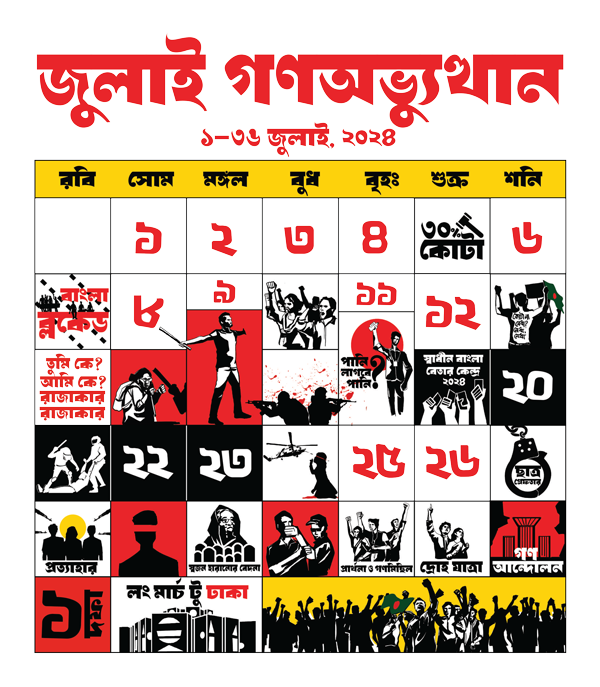
Timeline
The July Movement began as a protest against the quota system in Bangladesh's public service sector. A quota framework for the Bangladesh Civil Service was introduced shortly after independence in 1972, under which 20% of positions were filled based on merit, 40% were reserved by district, 30% for the families of freedom fighters, and 10% for survivors of sexual violence (birangona). The framework went through several permutations in subsequent years.
In 1997, the freedom-fighter quota was extended to their children, and where eligible candidates were not available, posts were reserved rather than reallocated. In 2010, the scheme expanded again to cover the grandchildren of freedom fighters. Since then, the state has maintained a configuration that reserved 56% of government jobs: 30% for descendants of freedom-fighters, 10% for women, 10% for under-represented districts, 5% for indigenous communities, and 1% for people with disabilities.
Intended to promote inclusion, the policy increasingly appeared inequitable: reserved seats were often left vacant, while higher-scoring candidates outside the purview of the quota were excluded. This mismatch between large reserved allocations and actual uptake fuelled discontent among students and jobseekers, culminating in three major waves of the quota reform movement in 2013, 2018 and 2024, which sought to redistribute recruitment in favor of merit while narrowing the scope of reservations.
In 2018, the quota provision for Class I and II civil service posts was abolished by government directive. However, it was reinstated through a High Court verdict on June 5, 2024, which led to nationwide student protests. In 2024, university students spearheaded the Anti-Discriminatory Student Movement, arguing that the quota system had become skewed to benefit supporters of the ruling Awami League.
Their demand for a merit-based and fair recruitment process gained widespread traction against a backdrop of rising graduate unemployment and economic pressure on middle- and lower-income families. As students were brutally attacked and shot at by police, security forces, and ruling party student cadres, the movement quickly evolved into a broader uprising involving people from all walks of life.
Key Moments
Timeline of the July Uprising
This is a working timeline based on the testimonies and reporting collected in The July Resolve. You can refine these entries later from the full text.
June 5, 2024
High Court reinstates 56% quota
The High Court annuls the 2018 circular that had abolished quotas for Class I and II civil service posts, reinstating a 56% quota including 30% for descendants of freedom fighters. Students and jobseekers see this as a return to inequality and begin protesting.
June 6, 2024
Six-campus protests against quota
Students at Dhaka, Jahangirnagar, Jagannath, Sher-e-Bangla Agricultural, Rajshahi and Chittagong universities hold rallies opposing the verdict and warn that the movement will intensify if the decision is not reversed.
July 4, 2024
Bangla Blockade announced
From Shahbagh, student leaders declare that from July 7 they will enforce a countrywide "Bangla Blockade" at key intersections to demand abolition of all "illogical quotas" through legislation.
July 7–13, 2024
Bangla Blockade halts the country
Road and rail blockades, class boycotts, and mass processions bring Dhaka and many districts to a standstill. The movement's one-point demand—abolish quotas and restore merit—captures national attention.
July 10–11, 2024
Nationwide spread and first major clashes
Blockades expand across highways and rail lines from Dhaka to Gazipur, Chattogram, Rajshahi, Cumilla, Khulna and Kushtia. At Cumilla University, police clash with students trying to occupy the Dhaka–Chattogram Highway; baton charges and tear gas leave at least 20 injured.
July 12–13, 2024
Repression escalates, voices multiply
Protesters again block Shahbagh and rail lines in Rajshahi while alleging that lawsuits are being used to intimidate organizers. Incidents like the beating of student-journalist Md. Tamim Hossain highlight increasing attempts to silence documentation.
Mid-July 2024
"Who Am I? Razakar!" slogan ignites movement
After the Prime Minister suggests quota benefits should go to freedom fighters' grandchildren rather than 'Razakars', students answer with defiant chants—'Who are you? Who am I? Razakar, Razakar!'—turning a slur into a rallying cry and deepening campus anger.
July 15, 2024
BCL attacks and open street battles
Following Awami League leader Obaidul Quader's claim that BCL is 'ready to respond', ruling-party student cadres attack protesters at Dhaka University and beyond. Hundreds are injured, emergency rooms are invaded, and near-simultaneous assaults are reported at Rajshahi, Cumilla and Jessore.
July 16, 2024
Killing of Abu Sayed; nationwide shutdowns
Overnight attacks at Jahangirnagar University are followed by lethal clashes in Rangpur, where Begum Rokeya University student Abu Sayed is shot dead by police. Forensic reconstructions later show he was unarmed and alone. Education authorities close schools and universities nationwide as deaths mount.
July 17, 2024
Countrywide clashes and mounting casualties
Funeral prayers for those killed are met with tear gas and further violence across Dhaka and other cities. Motorways, toll plazas and neighborhoods like Jatrabari burn; tens of thousands face police cases while students and faculty demand accountability and the withdrawal of security forces from campuses.
July 18, 2024
At least 17 killed and internet cut
Clashes near BRAC University and East West University, fires near Mirpur-10, and vandalism of Metro Rail infrastructure contribute to one of the bloodiest days. Authorities shut down mobile internet across much of Bangladesh and prepare for curfew and wider army deployment.
July 19, 2024
Curfew, bans on rallies, and children among the dead
Dhaka police ban all rallies and trains stop serving the capital as clashes spread across multiple thanas and districts. A nationwide curfew and troop deployment are announced. The day's toll includes children like Riya Gop, Abdul Ahad, Naima Sultana and Rakib Hasan, killed by bullets fired into homes and neighborhoods.
July 20, 2024
Late-night talks and alleged abduction of a coordinator
Three ministers hold midnight talks with protest leaders at the State Guest House while another key coordinator, Nahid Islam, is reportedly taken from a friend's home and later describes being blindfolded and tortured. In Savar, 14-year-old Saad Mahmud Khan is shot dead amid clashes.
July 21, 2024
Supreme Court ruling and more teenage deaths
After his release, Nahid Islam details torture in custody. The Supreme Court orders quotas reduced to 5% for war veterans' families and 2% for ethnic minorities, transgender people and persons with disabilities, leaving 93% of jobs on merit. On the streets, 16-year-old Arafat Rahman 'Akash' is shot dead in Savar.
July 22, 2024
48-hour pause and the 93/7 split
Student leaders announce a two-day pause in protests and urge lifting of curfew and harassment. The government issues a circular implementing a 93% merit, 7% quota split, but organizers reject it and insist justice for the dead and injured must come first.
July 23, 2024
Internet slowly returns, focus shifts to justice
Broadband service is restored after a five-day outage, though social media remains blocked. The movement's demands evolve into a nine-point charter centered on apology, resignations, accountability for killings, compensation, campus reopening and protections from reprisals.
July 24, 2024
Curfew eased; hospitals under strain; missing coordinators found
With curfew relaxed, factories, banks and offices reopen and traffic returns, but hospitals like DMCH report over a thousand injured treated in a week. Three student coordinators missing for days reappear, highlighting the climate of fear around enforced disappearances.
July 25, 2024
PM reappears; global pressure mounts
The Prime Minister makes her first public visit to damaged infrastructure, urging resistance to 'saboteurs', while key businessmen and opposition figures are arrested. UN human rights mechanisms and Western governments call for an end to lethal force, restoration of rights, and accountability.
July 26–27, 2024
Organisers seized; contested narratives and remand
Plainclothes officers remove three student coordinators from hospital, later claiming they sought 'security'; this comes after previous detentions. At the same time, an FIR on Abu Sayed's killing blames protesters rather than police, while a 17-year-old student, Hasnatul Islam Faiyaz, is placed on seven days' remand in a police-killing case.
July 28, 2024
Diplomatic pressure and 'stand-down' video from DB office
Fourteen foreign missions in Dhaka urge due process and restoration of internet. That night, six student coordinators appear in a video from Detective Branch custody announcing withdrawal of protests, amid photos of them dining with the DB chief; later, one alleges the message was scripted at gunpoint as arrests pass 9,000.
July 29, 2024
Highway blockades, calls to ban Jamaat, and mass cases
Rajshahi University students block the Dhaka–Rajshahi highway demanding justice and investigation. The ruling alliance moves to ban Jamaat–e-Islami and its student wing. Courts rebuke DB over its treatment of organizers as police file around 200 cases naming over 213,000 mostly unnamed individuals.
July 30, 2024
Nationwide mourning and the 'red tide' online
The government declares a day of mourning for those killed, while student leaders ask people to turn their profile photos into plain red squares. Social media fills with red, and fresh rallies by teachers, students and civic groups call for justice and an end to repression.
July 31, 2024
March for Justice and EU puts talks on hold
The Students Against Discrimination platform calls a 'March for Justice' across campuses, courts and streets, inviting broad social participation. The European Union postpones negotiations on a new cooperation pact, citing Bangladesh's violent response to protests.
August 1, 2024
Coordinators freed; Jamaat–Shibir banned; UN offers inquiry
Six key organizers are released from DB custody and immediately call for prayers and a mass procession. The government issues a gazette banning Jamaat–e-Islami and Islami Chhatra Shibir under the Anti-Terrorism Act, while the UN High Commissioner for Human Rights offers to send a fact-finding team.
August 2, 2024
Coordinators speak out and non-cooperation declared
Freed coordinators state that their DB office video withdrawing the movement was not voluntary. Thousands join the 'Droho Jatra' in Dhaka, marching from the Press Club to Shaheed Minar, and organizers announce nationwide demonstrations and an indefinite 'total non-cooperation' campaign.
August 3, 2024
One-point demand: resignation of the Prime Minister
Crowds swell at Shaheed Minar, Shahbagh, Farmgate and highways near Jahangirnagar University. Rejecting calls for dialogue, movement leaders crystallize a single demand: the resignation of the Prime Minister and Cabinet to ensure safety and justice for the people.
August 4, 2024
Curfew, rising casualties, and 'March to Dhaka' call
At least 91 deaths are reported among protesters, police and government supporters as clashes and attacks on ruling party targets spread to dozens of districts. Authorities impose an indefinite nationwide curfew and a three-day public holiday, while organizers call for a defiant 'March to Dhaka'.
August 5, 2024
Curfew defied and resignation confirmed
Despite curfew and an internet blackout, crowds converge on Dhaka's key points. By afternoon the Army Chief announces that Prime Minister Sheikh Hasina has resigned and left the country; jubilant crowds enter Ganabhaban and Parliament areas even as families count their dead, including teenagers like Shahrier Khan Anas and Golam Nafiz.
August 6, 2024
Calls for accountability and Yunus proposed as interim head
Rights groups insist that any transition must center justice for killings, injuries and mass arrests. Student leaders publicly propose Nobel laureate Muhammad Yunus to head an interim administration; he agrees, saying he feels a responsibility in light of the sacrifices made by students and citizens.
August 8, 2024
Yunus returns and is sworn in as interim leader
Muhammad Yunus flies back to Dhaka and is sworn in at Bangabhaban as head of an interim administration, in a ceremony attended by political figures, civil society, military leaders and diplomats. The July Movement's street uprising formally gives way to a transitional political order.