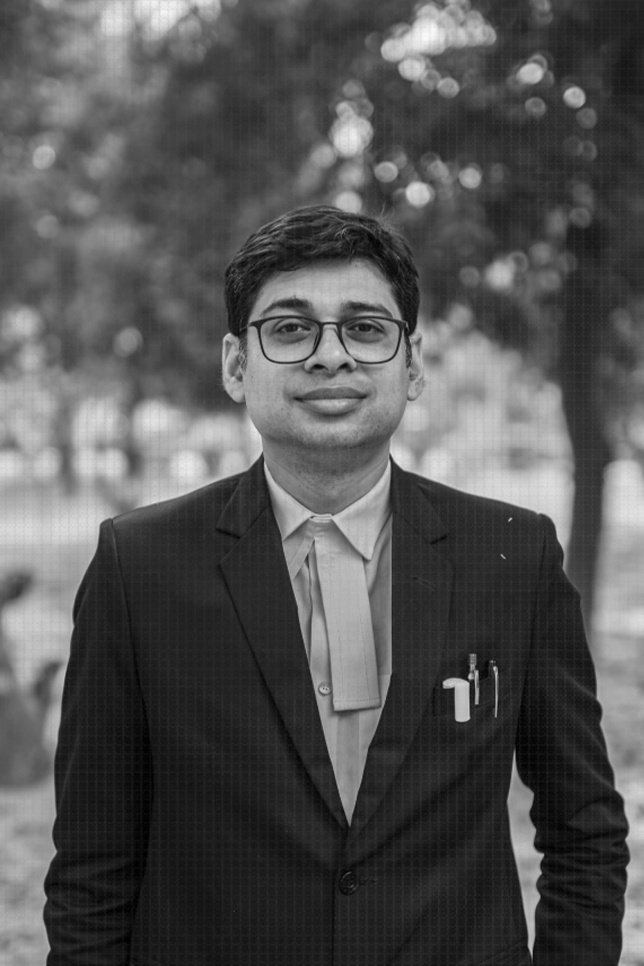
Manzur Al Matin, a 40-year-old lawyer and journalist from Dhaka, harboured deep grievances about the political situation in Bangladesh. As a talk show host, he faced direct interference in his work. “Two Members of Parliament, sent by the Prime Minister herself, asked my Managing Director to terminate me,” he recounted. “Then, there were elections where we couldn't report the shameless rigging. It was incredibly frustrating.” These experiences simmered within him, awaiting a trigger. That trigger came in July. Watching students being brutally attacked and killed, Manzur saw visions of his own 13-year-old son. “As a parent, I felt it was my responsibility to stand up. I might not succeed, but it was vital for me personally to protest,” he explained emotionally. “Abu Sayed's courage inspired me. He gave up his life standing up, urging everyone to demonstrate the bravery shown by Professor Shamsuzzoha, who once died protecting his students. And when the students were dying every day—six fatalities on the 16th, then 21 on the 18th —I knew it was time to act.”
On July 18th, Manzur, along with his wife and friends, took to the streets, armed only with a press card and a camera phone to document the horrific violence. It was the day young Farhan Fayaz was tragically killed. “Farhan was barely older than my son. I felt helpless, as if we had failed to protect our children. That despair quickly turned to rage and determination. Death was the only thing that could have stopped us.” he stated.
That same day, Manzur himself faced severe threats. Early in the morning, while documenting the protests from an overbridge, he was struck by a brick, and shortly after, a man attempted to beat him with a bamboo stick until students intervened. Undeterred, he returned home, uploaded footage, and went back out. This time, someone shot directly at him. “Someone aimed a pistol right at me. My friend warned me to take cover, but people around urged me to keep recording, saying, 'You must tell the world we're unarmed, and they're trying to kill us.' These were not the police," he also noted. Despite his close brush with death, Manzur rushed back home once more to upload the footage, then headed back to the streets. “There was, of course, some discouragement from my family,” he admitted, “But they all understood how important it was for me to go out.”
Manzur and his wife were torn between the importance of protesting and a deep awareness of the dangers. “Every day, both of us knew we could die out there,” he said. “Occasionally, we took turns to go out because we didn't want to orphan our son.” The gravity of their decision weighed on them constantly. “Every time we came back home, we thought—well, we may never be able to see all these wonderful people again.” Still, the decision to act was one he could not ignore. “If we hadn't gone out there, we wouldn't be able to look at ourselves in the mirror again. We wouldn't be able to stand tall” Manzur reflected. “It was important for us to do that. To be able to answer to ourselves.”
Initially, Manzur wasn't optimistic. “Sheikh Hasina had the police, the Border Guards Bangladesh (BGB), the Army, and lethal weapons were being unleashed on unarmed protesters, but we had to fight,” he said. However, his hope ignited during the internet blackout when thousands courageously took to the streets despite what they were going through. "People had prepaid electricity meters in my area, and due to the blackout, they couldn't recharge, yet they still marched out in huge numbers. Poor day labourers, rickshaw pullers—everyone knew they had to fight. A CNG driver told me, 'I'm ready to starve, but she has to go.' That moment, we knew Sheikh Hasina's time was over.”
“On the 18th of July, when students were forced to vacate their residential halls right after they managed to get rid of Chhatro League, I could feel a shift,” Manzur recalled. “As the public university students were pushed out, private university students began stepping up. And when the police came down hard on them, the school students came out next. That's when I noticed the police starting to waver.” He remembered addressing the press that day. “I said, 'The next time you pull your trigger, remember—it could be your son on the other side.' And tragically, that did happen. A student who was killed turned out to be the son of a police officer. The officer rushed from one hospital to another before finally finding his child's body riddled with bullets. He called his supervisor and said, 'Sir, how many bullets do you need to kill a child?'” “From that moment,” Manzur continued, “the Awami League's narrative that we were all Bangladesh Nationalist Party (BNP) and Jamaat sympathizers just collapsed on its head.”
Manzur also reflected on his late-night commute between talk shows and his protest-related duties. “I saw the soldiers guarding the protest zones. Their body language told a story of deep reluctance. It was obvious they didn't want to be there,” he observed. He also mentioned a meeting that was held by the Army Chief in his office where junior officers spoke up, “This is no army from Punjab. This isn't 1971, these are our own people, and you're making us shoot at our own children. This can't go on forever.” For Manzur, he felt there was definitely no turning back after that.
During that period, Manzur continued hosting some of his regular talk shows despite the challenges. “Electronic media was pretty much silenced,” he explained. “We weren't able to show the day's fatalities, but some newspapers were still reporting.” In response, Manzur found a simple yet powerful tool to inform the public: “The only thing I could do was read out the newspaper from that morning. Reading the morning's newspaper at 11:30 PM on television might seem ridiculous under normal circumstances, but that was the best news I could give to my audience.” Even this small act drew attention from the authorities. “I was getting phone calls from the Directorate General of Forces Intelligence (DGFI), military intelligence, and so on, simply for reading out the newspaper,” he said.
Manzur also took to the streets in solidarity with cultural activists and friends involved in group theatre and cultural wings of political parties. “They kicked off the protest,” he recalled. “We held a human chain in front of Jatiyo Sangshod, followed by a rally where we sang anthems of protest. We were surrounded by the military, police, and BGB on all sides. But we said, ''Go down with Sheikh Hasina and that felt real.""
"Eventually, as lawyers, we felt it was essential to push for formal accountability," Manzur reflected. “We were trying to build a commission to investigate the deaths" Manzur explained. “When the blackout was partially lifted and the students once again declared their intention to protest, my colleague and I decided to file a writ petition.”
Their legal appeal had two urgent demands. “First,” Manzur said, “we asked the court to immediately halt the indiscriminate use of live ammunition. Second, we called for the release of the six coordinators of the student movement, who were being detained completely illegally.”
The writ petition attracted widespread media attention. “That was the first time electronic media began acknowledging that people were being slaughtered across the country,” he recounted. “Once our press conference aired on nearly every television channel, the public finally began to understand the full extent of what was happening.” Manzur and his peers made it a point to graphically describe how the military was shooting innocent people with assault rifles. “That gained a lot of attention and managed to inform the public,” he explained proudly.
He also had the opportunity to speak with Nahid Islam, the Founding Convenor of National Citizen Party (NCP), and Nasir Uddin Patwary, now the Chief Coordinator of NCP, along with members of the Teachers Network. “We had a meeting on the 4th of August to plan how we could manage the gathering and march on the 5th,” he recalled. “We were supposed to have another meeting with Mahfuz Alam, now the advisor of Information and Broadcasting, Nahid, and Nasir the next day. But on August 5th, police held a gun to Mahfuz's stomach, preventing him from coming to our venue. Shortly after, the news came that the Army Chief would address the nation. That's when we realized things were pretty much done,” Manzur said.
Although the movement successfully ousted Sheikh Hasina from power that very day (August 5th), Manzur recalls how deeply draining it all was for him—emotionally, physically, and mentally. “At times, we felt completely burned out. We felt we could no longer push ourselves because so many people were being killed in such gruesome ways,” he said. The trauma did not end with the protests. “After the movement, many of the Shaheed families came to me for legal guidance. Talking to those families was extremely painful.” He paused, reflecting on the magnitude of what had unfolded. “The whole month of July has forever changed my life. These are traumas that will never leave us.”
Yet amidst the sorrow, Manzur also recognized the victory. “We emerged victorious. We lived to see another day. That's something I'm grateful for,” he acknowledged. “At the same time, it gives us the burden of taking our nation forward, because all these people gave up their lives for some sustainable change. It's now incumbent upon the rest of us who survived to fight for that, for as long as we can. We survived to continue fighting for the change these martyrs died for.”
When asked if he would make the same sacrifices again, Manzur was unequivocal: “A hundred times over. I always regretted not being alive in 1971 to fight the Liberation War. This movement granted me that honour.”
Manzur now turned to reflect more deeply on the broader outcomes of the movement, recognizing that it achieved only its primary objective. “Its primary goal was to get rid of Sheikh Hasina, and it has done that,” he explained. “But the second declared goal was to dismantle the fascist regime, which is a much more complex undertaking. And I don't see our current political parties demonstrating the commitment we need to achieve that.” He continued, I think the only thing that could have given us a better chance (at achieving that second goal) is if the movement itself could have continued a bit longer. It would have allowed the forces participating in the movement to cement their unity and find common ground under very compelling circumstances—but that would have claimed so many more lives, and that isn't something we could ever want.
Still, Manzur believes there is hope. “After the revolution, it's important that we regroup and find common ground—and that can still be done. We also understand there are many forces, both within and outside the country, that want the fascist regime to return. As long as we remain aware of that, it shouldn't be difficult for the political forces and others involved in the movement to find a common ground.”
Reflecting on the future of leadership in Bangladesh, Manzur was hopeful that July would serve as a lasting warning to authoritarian rulers. “I think July will prove to be a cautionary tale for leaders for the foreseeable future,” he said. “It shows that no matter how powerful a state is, no matter how advanced your surveillance equipment is, you can't really stop the inevitable. You can't remain in power indefinitely.” He added, “Whoever aspires to lead Bangladesh next will bear that in mind. And July has been closely observed by the world. People I've spoken to from Sudan, Egypt, Palestine, Ukraine, Nepal, and Sri Lanka—they're all watching. They're all hopeful. They believe good things are possible because July was possible in Bangladesh.”
Building on his reflections about the outcomes and future of the movement, Manzur then turned to the question of reconciliation—how should the country move forward after such immense loss and upheaval? He shared a firm and clear stance on what is needed for true reconciliation. “In terms of reconciliation, I think there are two preconditions,” he stated. “Firstly, there must be trials and punishment for the July massacres. The perpetrators must be identified, tried, and punished. Without that, there can be no reconciliation.”
He continued, “Secondly, at the very least, the Awami League must admit to the atrocities it has committed—and apologize. Without an admission of guilt, I don't see any possibility of reconciliation moving toward.”
While he emphasized on the need for healing and unity in the country, Manzur was equally clear that reconciliation cannot be one-sided. “I appreciate the fact that it's very important to reintegrate a society,” he acknowledged, “yet it can't be a onesided process. Reconciliation is a reciprocal process where both parties need to come forward with open hearts and take responsibility.”
He concluded, “If the people supporting Awami League remain in denial—continuing to gaslight, insisting there were no human rights violations, claiming the economy was doing well—then it becomes very difficult to reach out to them.”
Ultimately, Manzur learned that unity is crucial. “No matter the challenge, if we stand united, we can overcome anything. My advice to future generations is simple: remain hopeful and always wish for better days ahead.” His concluding message resonates: “United we stand, divided we fall.”