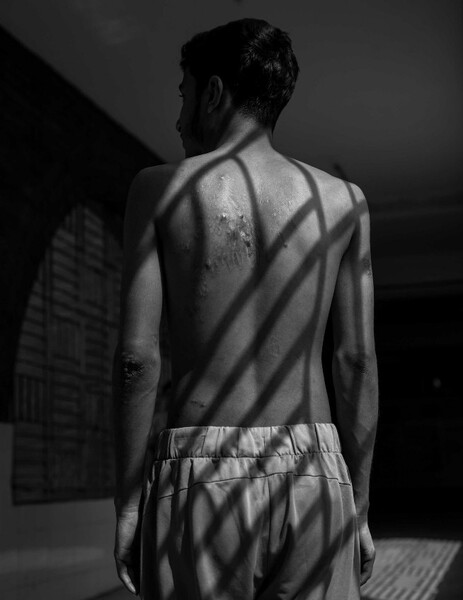
Masum Mia, a 23-year-old transport worker from Mymensingh, joined the quota reform movement out of a sense of responsibility to his country and the younger generation. “I may not have been a student myself, but I felt their demands were logical,” he said. Having left school to support his family, Masum was determined to ensure that future generations would not face the same injustices that had shaped his own life.
“I thought that even if I can't study myself, I can at least stand for those who can.” When asked about what had finally propelled him, Masum recalled a pivotal moment on July 18 in Badda and Shahjadpur. “The spirit of the younger students amazed me,” he said. “They were fearless even as tear gas burned their eyes. Their courage gave me hope.” The risks were constant. On July 19, police tried to arrest him at home, accusing him of taking part in the protests. “Though they had no proof, they continued to threaten and verbally abuse me,” he said. “That night I couldn't sleep, but I knew I had to keep going.”
August 5 changed everything. In the evening, during the Bijoy Michil (Victory Rally), he saw millions on the streets and thought freedom had finally arrived. Then gunfire erupted. Breaking news reported the Prime Minister's resignation, and the Army arrived on the scene, firing in the air to protect the crowd — but the police kept shooting, and some soldiers were injured. Masum moved with the Army until an officer next to him was hit. They retreated and found themselves with 500 to 1,000 people cornered on a side street. Random gunfire ensued. People started to scatter, but a small group, ten to twelve strong, including Masum, could not escape. “We were all shot. I was hit four times — in my hands, hip, and back,” he said. He faded in and out.
“I heard a police officer say, 'Throw away the dead bodies.' They kicked us. The police were firing indiscriminately. Bodies were everywhere.” Police officers, assuming he was dead, dragged him and propped him up. “They asked if I was alive, then ordered me to run toward the protesters to scare them — or they'd shoot me,” he recalled. He could barely stand. He collapsed again and remembers little for the next two or three hours. He briefly regained consciousness in Malibagh Hospital, and was then taken to Dhaka Medical College Hospital, where trolleys held hundreds of injured, and the cries of families reverberated all around. On August 6, he was transferred to Pongu Hospital.
Multiple surgeries followed, and an iron implant now supports his hand, which he needs to carry for five to six years. “I can move it, but the pain is constant,” he said. The trauma lingers as well. “I forget things quickly now. I'm not the same person I once was.”
Even with that pain, he holds on to what the movement achieved. “We achieved something priceless — freedom of expression,” he said. “People can now criticize the government and speak openly without fear, which we couldn't do for 15 long years. That makes the sacrifice worth it.”
At the same time, he hopes the state will match that accomplishment with care for the wounded. “Many of us need physical rehabilitation and financial stability. We gave everything for this country. Now we need the chance to rebuild.”
He has no regrets. “If I get the chance, I'll do it again. Bullets don't scare me anymore.”
As he continues to recover, Masum's spirit remains unbroken. “I may no longer have a normal life,” he said, “but I know that what we did was to secure a better future for all of us.”