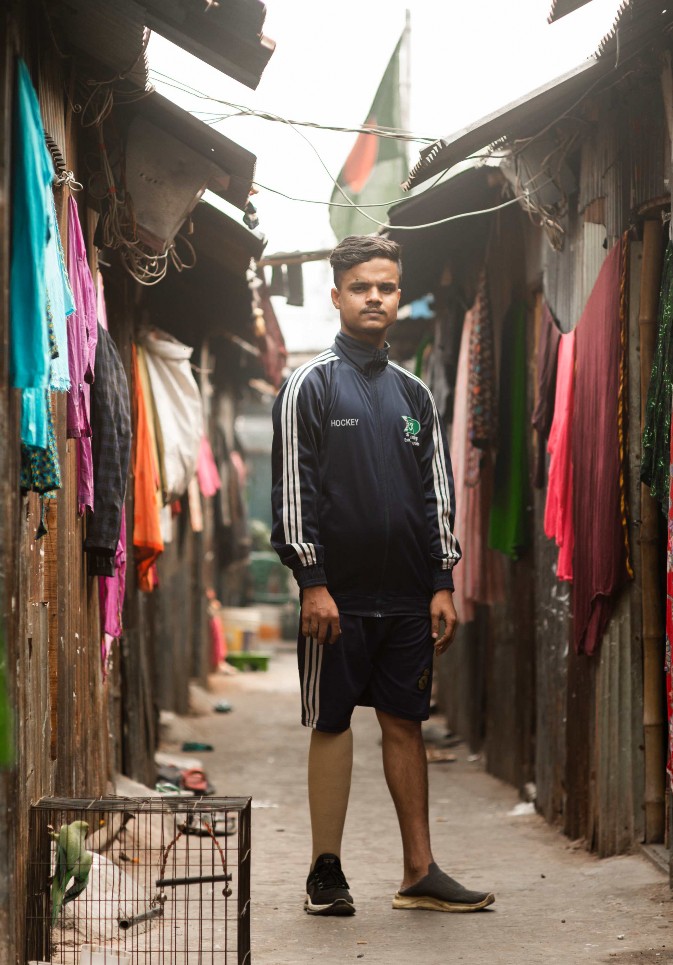
Md Mustakim, a 23-year-old driver from Kishoreganj, was drawn into the quota reform movement, not as a student, but as a concerned citizen. His journey began unexpectedly one Friday when a visit to repair his mobile phone led him to encounter a group of protesting students. “I recognized some familiar faces,” he recalled. “Seeing them and their passion moved me. I decided then and there to join them.”
When asked about what had motivated him, Mustakim spoke of the systemic corruption and lack of discipline in the country that had shaped his life as a driver. He had endured harassment from the police and witnessed the struggles of ordinary people. Joining the students felt like a chance to stand for something bigger than himself. “I wanted to support the students for quota reformation,” he said simply.
But Mustakim's involvement came at a steep price. On his very first day on the ground, he was shot by a sniper. “I had no idea such a thing could happen,” he said. “I thought there'd be police chases and rubber bullets, but I had no idea they'd actually use sniper bullets.”
The memory of that day is seared into his mind. After hours of standing with the protesters, Mustakim stepped aside to rest. Suddenly, gunfire erupted. “I felt a sharp sting in my leg and then numbness,” he recounted. “When I looked down, my leg was bent backward unnaturally. I shouted for help, and my friends rushed to carry me.”
The next few hours were a blur of pain and desperation. Mustakim was taken to several hospitals, each more overwhelmed and underprepared than the last. At Suhrawardy Hospital, he was placed on the floor amongst the scores of dead bodies. Blood loss left him drifting in and out of consciousness. Eventually, he was taken to Pongu Hospital, where doctors discovered that the sniper bullet had exploded inside his leg, causing a severe infection. “They said the gunpowder residue had made it impossible to save my leg,” he explained. “They amputated it to prevent the infection from spreading.”
The physical toll was immense, but the emotional and psychological scars were equally deep. “I feel like a different person now,” Mustakim admitted. “Though I'm grateful to be alive, the mental struggle is constant. I've lost my sense of normalcy.” Despite the challenges, he expressed gratitude for the support he has received from his family, a non-profit organization that provided him with a prosthetic leg, and strangers who showed him kindness during his darkest moments.
Reflecting on the movement, Mustakim believes the sacrifices were worth it. “The fascist government fled, and the country is freer now,” he said. “We can speak out without fear, and that's priceless.” Still, Mustakim acknowledges the lingering challenges. He emphasized the need for psychological and financial support for injured protesters like him. “I want to start a business and rebuild my life,” he said.
Despite the pain and loss, Mustakim remains proud of his role in the movement. “I may have lost a leg,” he said, “but I haven't lost my pride or my hope for the future.”