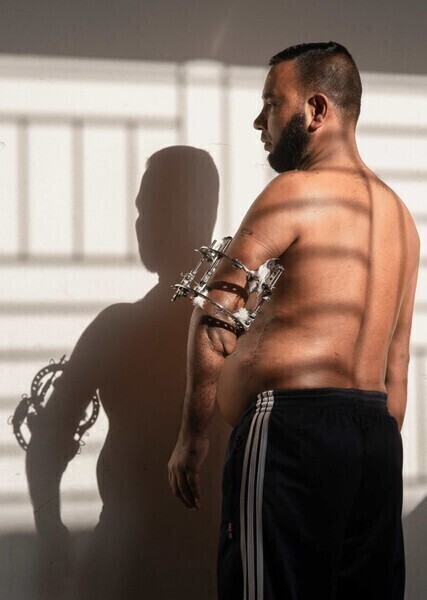
Mosharaf Hossen, a 40-year-old fuel seller from Kishoreganj, had always lived a meagre existence, focused on providing for his wife and three children. But everything changed when he saw students being brutalized and killed during the protests. The violence was everywhere—on the news, in the streets, and in the whispered fears of neighbours. Mosharaf couldn't ignore it any longer.
When asked what motivated him to finally join the protests, he recalled the words of his seventh-grade daughter, who asked him, “Father, can't people do anything when students are being killed?” Her question ignited something deep within him. Despite knowing the risks, Mosharaf felt he had to stand up—not just for the students, but for the future of his own children. He joined the movement with the fervent hope that the government would listen to the students' demands. But as the days passed, he witnessed scenes that would be forever imprinted in his mind: bodies of students being loaded into vans, protesters running for their lives as police opened fire.
“They started shooting at us like we were nothing,” he later recounted.
At that moment, his goals shifted. It wasn't just about the students anymore—it was about standing against oppression. For Mosharaf, this was a fight for dignity, justice, and the hope that his children might inherit a better world. The protests were perilous, but Mosharaf braved the narrow streets, dodging bullets and tear gas. One day, during a rally that filled him with hope, tragedy struck. The police suddenly arrived, and gunfire erupted. A bullet pierced his left hand, and he collapsed, overwhelmed by excruciating pain. In that moment of desperation, his thoughts turned to his family.
“All I could think of was my three children,” he said. “I prayed to be able to see them one last time.”
What followed was a harrowing journey for survival. Bleeding profusely, Mosharaf was rushed from one hospital to another, only to be turned away. The rejection was relentless — doctors either lacked the resources or were too afraid to treat an injured protester. Finally, Mosharaf underwent surgery at the National Orthopaedic (Pongu) Hospital. By then, he had lost so much blood that his survival was uncertain. Over the course of nine surgeries, doctors managed to save his life, but his left hand was permanently disabled. The man who had once earned Tk 50,000 a month now found himself unable to work.
The aftermath has been devastating for Mosharaf and his family. The financial strain is immense, and he struggles with his disability every single day. Yet, despite everything, he draws strength in the love and respect he receives from his family and community.
“People say, 'You lost your hand but brought us freedom.' That means the world to me.”
Upon reflection, Mosharaf knows he paid a high price for the decision he made that fateful day, but he believes it was necessary. “We wanted peace,” he says. “We were ready to give everything for it—even our lives. We told ourselves that we'd keep going until peace was achieved, and finally it happened, Alhamdulillah. Sheikh Hasina's resignation stands as one of our most valuable achievements.” Yet what he sees now troubles him.
“I hear that prices of daily essentials have gone up, and there has been an increase in robberies and attacks. This isn't what we wanted. This isn't what we fought for.” He does not want others to suffer because of the movement he took part in. “We never wanted our movement to create hardship. If the current government doesn't support us, we'll all suffer, and our families may lose everything—including our dignity.” For the injured, his request is clear and urgent. “My treatment will continue for another year, but my hand will never fully recover. We need financial help now. I'm grateful for the treatment we're receiving from the government, but what we need is rehabilitation and a permanent source of income. Once we have that, we'll have no other wishes."
“I hear that prices of daily essentials have gone up, and there has been an increase in robberies and attacks. This isn't what we wanted. This isn't what we fought for.” He does not want others to suffer because of the movement he took part in. “We never wanted our movement to create hardship. If the current government doesn't support us, we'll all suffer, and our families may lose everything—including our dignity.” For the injured, his request is clear and urgent. “My treatment will continue for another year, but my hand will never fully recover. We need financial help now. I'm grateful for the treatment we're receiving from the government, but what we need is rehabilitation and a permanent source of income. Once we have that, we'll have no other wishes." ready to give everything for it—even our lives. We told ourselves that we'd keep going until peace was achieved, and finally it happened, Alhamdulillah. Sheikh Hasina's resignation stands as one of our most valuable achievements.” Yet what he sees now troubles him.
“I hear that prices of daily essentials have gone up, and there has been an increase in robberies and attacks. This isn't what we wanted. This isn't what we fought for.”
He does not want others to suffer because of the movement he took part in. “We never wanted our movement to create hardship. If the current government doesn't support us, we'll all suffer, and our families may lose everything—including our dignity.”
For the injured, his request is clear and urgent.
“My treatment will continue for another year, but my hand will never fully recover. We need financial help now. I'm grateful for the treatment we're receiving from the government, but what we need is rehabilitation and a permanent source of income. Once we have that, we'll have no other wishes."
The struggle left him with hard-won lessons. “We learned how to fight. If we have to do this again, we'll be more prepared and more determined.”