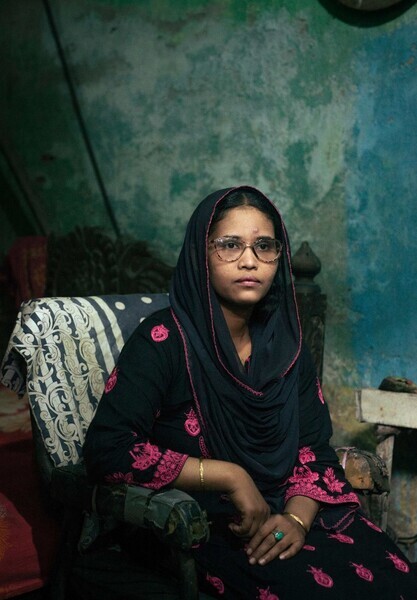
When asked about her motivation to join the movement, 21-year-old Nupur Chowdhury from Patuakhali spoke with quiet determination. “This is my country,” she said simply. “I saw so many of my brothers and sisters injured and killed. If they can fight, why not me? I don't have a father, mother, or family. I'm an orphan. I'll die one day—so why not for the country?”
Her words reflected a profound sense of belonging and duty, born out of a life shaped by loss. Orphaned at 13, Nupur grew up without the safety net of a family, relying only on herself and her courage and fortitude.
Nupur's resolve was shaped not by politics, but by humanity. “I don't understand politics,” she admitted. “But I saw people being killed for speaking the truth. This government killed its own people just to cling to power. I couldn't just sit idly by. ” Her voice quivered as she recalled the turning point: the death of Abu Sayed. “When our brothers were being killed, how could I stay silent?” Nupur joined the protests with no expectations or personal agenda—driven by anger and a desire to ensure a better future for the next generation. “The state has done nothing for me as an orphan. If I don't stand up now, my children will have nothing either,” she said.
Her experience of the protests was marked by a deep sense of anger, betrayal and frustration. “We hated the police,” she confessed. “We witnessed their brutality firsthand, and we knew they served only the government, not the people.”
On August 5th, during the Bijoy Michil (Victory March), Nupur was shot. “We were happy that day. None of us imagined we could be attacked,” she recalled. But at Mirpur-2, bullets rained down on the protesters. “Three bullets penetrated one leg, and another into the other. I was taken to the Heart Foundation, then to Pongu Hospital. When I woke up at 4 a.m., the doctors told me one bullet would remain in my leg forever—unless I wanted to risk losing it entirely.”
Nupur's recovery has been a gruelling process, both physically and emotionally. She can walk now, but the pain of the embedded bullet is a constant reminder of her sacrifice. “I'm proud of myself,” she said, her voice steady despite all the trials she has endured. “People love and support me. That gives me strength. I want to keep my patience and courage intact.” But the challenges of daily life weigh heavily on her.
“I can't work as I used to. I need a job to survive. I have no family, no financial stability, no future. That's my reality.”
When reflecting on whether the sacrifice was worth it, Nupur's conviction did not waver. “Giving my life or almost losing it for my country is the worthiest thing I've ever done.”