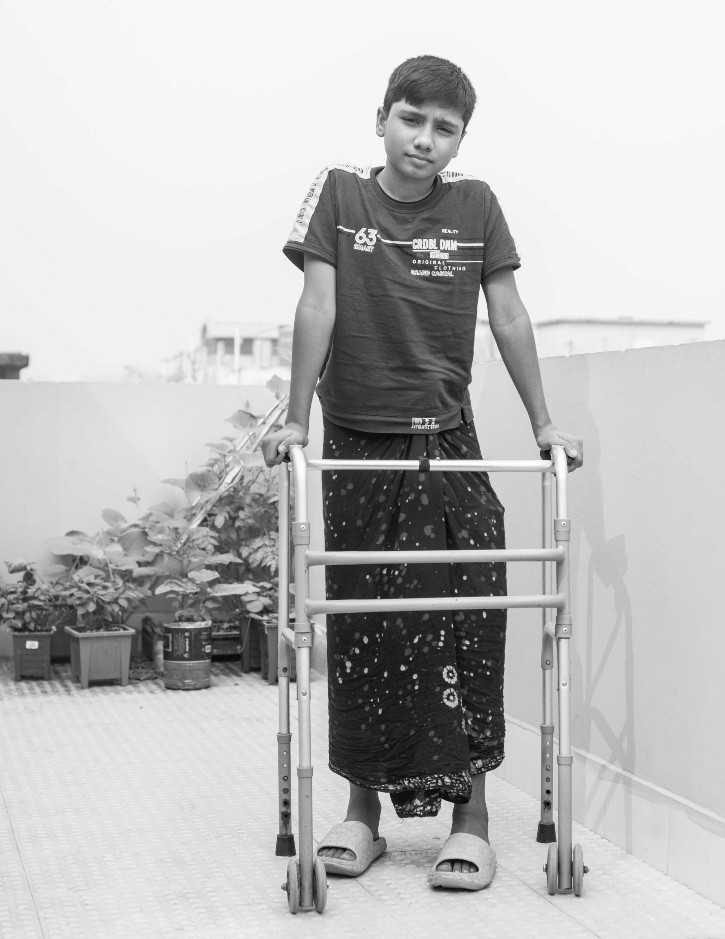
At just 12 years old, sixth grader Shahriar-or-Rashid felt the pull of the streets. Every day, he watched the older boys from his neighbourhood leave for the protests. “I saw one of the brothers get hit by a rubber bullet and become paralyzed. That stayed with me and affected me deeply. I felt I had to join”, he said.
He began to follow the boys at a distance, even when they warned him to stay back because they knew his mother would be furious with them for influencing him. He lied to his family, telling them he was 0ff to play football, only to slip into the crowds. By July 19, he had already been hit once by a rubber bullet. The older boys pulled him into a safe corner and held on to him until the chaos passed. Still, he returned. On August 4, he saw a man get shot and tried to help carry him to the hospital, but the man died. Shahriar himself was hit again by a rubber bullet that same day and went to Ajmal Hospital, where a nurse extracted the round and applied ointment before he went home. That night, Jamuna TV aired footage that showed him at a protest. His grandmother recognized him and told his mother, who then locked him indoors.
The next afternoon, August 5, he watched the Bijoy Michil (Victory Rally) from his window and convinced himself it would be safe. Everyone seemed to be moving toward Gonobhaban, and the mood was one of optimism and hope. He managed to slip out to join the march. Near Mirpur-2 Model Thana around 3:30 p.m., police told the crowd to go ahead and declared they would not stand in their way. Moments later, the officers fired tear gas, hurled sound grenades, and fired live ammunition rounds. Shahriar darted behind a pillar as people fell all around him. He saw an older brother get shot and, while looking at him, missed the officers who had moved up behind him.
“A madrasa student called out to me,” he remembered. “I turned and saw three policemen heading towards me. They loaded their rifles and shot me.” He collapsed, and students carried him to Al-Helal Hospital at Mirpur-10. From there, he was transferred to Pongu Hospital.
Doctors at Pongu dressed the wound and stopped the bleeding, but said a vein was torn and surgery was required. They sent him to Hridrog Hospital for the procedure. On August 7, he returned to Pongu for bone surgery. Surgeons placed a long iron rod in his leg, and plastic surgery set a circular ring on the limb—but he was later told the ring had been positioned incorrectly, and that removing it might risk amputation. “There were three bullets,” he explained. “They entered at one end and exited the other.”
In the beginning, he could not even sit up. He is now recovering slowly, with doctors cautiously predicting that he could walk after the ring is removed—assuming, of course, that removal can be done safely.
Life at home is difficult. His father is paralyzed, and his mother sells clothes as a hawker. The cost of treatment has strained the family's finances. Shahriar cannot walk, run, play, or go to school as he did before. Even so, he holds on to the outcome that he holds most sacred. “We wanted Sheikh Hasina to step down,” he said quietly. “That happened.”
Asked whether the sacrifice was worth it, he answers without hesitation. “Yes,” he said. “Given the chance, I'd go again.”